

Databricks Databricks-Certified-Data-Engineer-Associate Dumps Updated Jul 30, 2026 WIith 234 Questions
View All Databricks-Certified-Data-Engineer-Associate Actual Free Exam Questions Jul 30, 2026 Updated
The GAQM Databricks-Certified-Data-Engineer-Associate (Databricks Certified Data Engineer Associate) Certification Exam is designed for individuals who are interested in pursuing a career in data engineering. Databricks Certified Data Engineer Associate Exam certification exam is developed in collaboration with Databricks, a leading data and AI company that provides a unified analytics platform for data engineering, data science, and machine learning. The Databricks-Certified-Data-Engineer-Associate exam tests candidates on their knowledge of data engineering principles, practices, and tools.
NEW QUESTION # 121
An engineering manager wants to monitor the performance of a recent project using a Databricks SQL query. For the first week following the project's release, the manager wants the query results to be updated every minute. However, the manager is concerned that the compute resources used for the query will be left running and cost the organization a lot of money beyond the first week of the project's release.
Which of the following approaches can the engineering team use to ensure the query does not cost the organization any money beyond the first week of the project's release?
- A. They can set the query's refresh schedule to end on a certain date in the query scheduler.
- B. They can set the query's refresh schedule to end after a certain number of refreshes.
- C. They can set a limit to the number of DBUs that are consumed by the SQL Endpoint.
- D. They cannot ensure the query does not cost the organization money beyond the first week of the project's release.
- E. They can set a limit to the number of individuals that are able to manage the query's refresh schedule.
Answer: A
Explanation:
In Databricks SQL, you can use scheduled query executions to update your dashboards or enable routine alerts. By default, your queries do not have a schedule. To set the schedule, you can use the dropdown pickers to specify the frequency, period, starting time, and time zone. You can also choose to end the schedule on a certain date by selecting the End date checkbox and picking a date from the calendar. This way, you can ensure that the query does not run beyond the first week of the project's release and does not incur any additional cost. Option A is incorrect, as setting a limit to the number of DBUs does not stop the query from running. Option B is incorrect, as there is no option to end the schedule after a certain number of refreshes. Option C is incorrect, as there is a way to ensure the query does not cost the organization money beyond the first week of the project's release. Option D is incorrect, as setting a limit to the number of individuals who can manage the query's refresh schedule does not affect the query's execution or cost. Reference: Schedule a query, Schedule a query - Azure Databricks - Databricks SQL
NEW QUESTION # 122
A data engineer wants to create a new table containing the names of customers that live in France.
They have written the following command:
A senior data engineer mentions that it is organization policy to include a table property indicating that the new table includes personally identifiable information (PII).
Which of the following lines of code fills in the above blank to successfully complete the task?
- A. COMMENT "Contains PII"
- B. PII
- C. There is no way to indicate whether a table contains PII.
- D. TBLPROPERTIES PII
- E. "COMMENT PII"
Answer: A
Explanation:
In Databricks, when creating a table, you can add a comment to columns or the entire table to provide more information about the data it contains. In this case, since it's organization policy to indicate that the new table includes personally identifiable information (PII), option D is correct. The line of code would be added after defining the table structure and before closing with a semicolon. Reference: Data Engineer Associate Exam Guide, CREATE TABLE USING (Databricks SQL)
NEW QUESTION # 123
A data engineer has a Python notebook in Databricks, but they need to use SQL to accomplish a specific task within a cell. They still want all of the other cells to use Python without making any changes to those cells.
Which of the following describes how the data engineer can use SQL within a cell of their Python notebook?
- A. They can attach the cell to a SQL endpoint rather than a Databricks cluster
- B. They can change the default language of the notebook to SQL
- C. They can simply write SQL syntax in the cell
- D. They can add %sql to the first line of the cell
- E. It is not possible to use SQL in a Python notebook
Answer: D
Explanation:
In Databricks, you can use different languages within the same notebook by using magic commands. Magic commands are special commands that start with a percentage sign (%) and allow you to change the behavior of the cell. To use SQL within a cell of a Python notebook, you can add %sql to the first line of the cell. This will tell Databricks to interpret the rest of the cell as SQL code and execute it against the default database. You can also specify a different database by using the USE statement. The result of the SQL query will be displayed as a table or a chart, depending on the output mode. You can also assign the result to a Python variable by using the -o option. For example, %sql -o df SELECT * FROM my_table will run the SQL query and store the result as a pandas DataFrame in the Python variable df. Option A is incorrect, as it is possible to use SQL in a Python notebook using magic commands. Option B is incorrect, as attaching the cell to a SQL endpoint is not necessary and will not change the language of the cell. Option C is incorrect, as simply writing SQL syntax in the cell will result in a syntax error, as the cell will still be interpreted as Python code. Option E is incorrect, as changing the default language of the notebook to SQL will affect all the cells, not just one. Reference: Use SQL in Notebooks - Knowledge Base - Noteable, [SQL magic commands - Databricks], [Databricks SQL Guide - Databricks]
NEW QUESTION # 124
A data engineering team has noticed that their Databricks SQL queries are running too slowly when they are submitted to a non-running SQL endpoint. The data engineering team wants this issue to be resolved.
Which of the following approaches can the team use to reduce the time it takes to return results in this scenario?
- A. They can turn on the Auto Stop feature for the SQL endpoint.
- B. They can increase the cluster size of the SQL endpoint.
- C. They can turn on the Serverless feature for the SQL endpoint.
- D. They can turn on the Serverless feature for the SQL endpoint and change the Spot Instance Policy to
"Reliability Optimized." - E. They can increase the maximum bound of the SQL endpoint's scaling range
Answer: C
Explanation:
Option D is the correct answer because it enables the Serverless feature for the SQL endpoint, which allows the endpoint to automatically scale up and down based on the query load. This way, the endpoint can handle more concurrent queries and reduce the time it takes to return results. The Serverless feature also reduces the cold start time of the endpoint, which is the time it takes to start the cluster when a query is submitted to a non- running endpoint. The Serverless feature is available for both AWS and Azure Databricks platforms.
Databricks SQL Serverless, Serverless SQL endpoints, New Performance Improvements in Databricks SQL
NEW QUESTION # 125
Which of the following approaches should be used to send the Databricks Job owner an email in the case that the Job fails?
- A. MLflow Model Registry Webhooks
- B. Manually programming in an alert system in each cell of the Notebook
- C. Setting up an Alert in the Job page
- D. There is no way to notify the Job owner in the case of Job failure
- E. Setting up an Alert in the Notebook
Answer: C
NEW QUESTION # 126
A data engineer has been given a new record of data:
id STRING = 'a1'
rank INTEGER = 6
rating FLOAT = 9.4
Which of the following SQL commands can be used to append the new record to an existing Delta table my_table?
- A. UPDATE VALUES ('a1', 6, 9.4) my_table
- B. UPDATE my_table VALUES ('a1', 6, 9.4)
- C. INSERT INTO my_table VALUES ('a1', 6, 9.4)
- D. INSERT VALUES ( 'a1' , 6, 9.4) INTO my_table
- E. my_table UNION VALUES ('a1', 6, 9.4)
Answer: C
Explanation:
To append a new record to an existing Delta table, you can use the INSERT INTO statement with the VALUES clause. This statement will insert one or more rows into the table with the specified values.
Option A is the only code block that follows this syntax correctly. Option B is incorrect, as it uses the UNION operator, which will return a new table that is the union of two tables, not append to an existing table. Option C is incorrect, as it uses the INSERT VALUES statement, which is not a valid SQL syntax.
Option D is incorrect, as it uses the UPDATE statement, which will modify existing rows in the table, not append new rows. Option E is incorrect, as it uses the UPDATE VALUES statement, which is also not a valid SQL syntax. References: Insert data into a table using SQL | Databricks on AWS, Insert data into a table using SQL - Azure Databricks, Delta Lake Quickstart - Azure Databricks
NEW QUESTION # 127
Which of the following describes a benefit of creating an external table from Parquet rather than CSV when using a CREATE TABLE AS SELECT statement?
- A. CREATE TABLE AS SELECT statements cannot be used on files
- B. Parquet files have a well-defined schema
- C. Parquet files can be partitioned
- D. Parquet files will become Delta tables
- E. Parquet files have the ability to be optimized
Answer: B
Explanation:
Option C is the correct answer because Parquet files have a well-defined schema that is embedded within the data itself. This means that the data types and column names of the Parquet files are automatically detected and preserved when creating an external table from them. This also enables the use of SQL and other structured query languages to access and analyze the data. CSV files, on the other hand, do not have a schema embedded in them, and require specifying the schema explicitly or inferring it from the data when creating an external table from them. This can lead to errors or inconsistencies in the data types and column names, and also increase the processing time and complexity.
CREATE TABLE AS SELECT, Parquet Files, CSV Files, Parquet vs. CSV
NEW QUESTION # 128
A data engineer is attempting to drop a Spark SQL table my_table and runs the following command:
DROP TABLE IF EXISTS my_table;
After running this command, the engineer notices that the data files and metadata files have been deleted from the file system.
Which of the following describes why all of these files were deleted?
- A. The table's data was smaller than 10 GB
- B. The table's data was larger than 10 GB
- C. The table was external
- D. The table was managed
- E. The table did not have a location
Answer: D
Explanation:
Explanation
managed tables files and metadata are managed by metastore and will be deleted when the table is dropped .
while external tables the metadata is stored in a external location. hence when a external table is dropped you clear off only the metadata and the files (data) remain.
NEW QUESTION # 129
Identify how the count_if function and the count where x is null can be used.
Consider a table random_values with below data.
What would be the output of below query?
select count_if(col1 > 1) as count_a, count(*) as count_b,count(col1)
as count_c from random_values
col1
0
1
2
NULL
2
3
- A. 3 6 6
- B. 4 6 5
- C. 3 6 5
- D. 4 6 6
Answer: C
NEW QUESTION # 130
A data engineer and data analyst are working together on a data pipeline. The data engineer is working on the raw, bronze, and silver layers of the pipeline using Python, and the data analyst is working on the gold layer of the pipeline using SQL The raw source of the pipeline is a streaming input. They now want to migrate their pipeline to use Delta Live Tables.
Which change will need to be made to the pipeline when migrating to Delta Live Tables?
- A. The pipeline will need to use a batch source in place of a streaming source.
- B. The pipeline will need to be written entirely in SQL.
- C. The pipeline can have different notebook sources in SQL & Python.
- D. The pipeline will need to be written entirely in Python.
Answer: C
Explanation:
When migrating to Delta Live Tables (DLT) with a data pipeline that involves different programming languages across various data layers, the migration does not require unifying the pipeline into a single language. Delta Live Tables support multi-language pipelines, allowing data engineers and data analysts to work in their preferred languages, such as Python for data engineering tasks (raw, bronze, and silver layers) and SQL for data analytics tasks (gold layer). This capability is particularly beneficial in collaborative settings and leverages the strengths of each language for different stages of data processing.
Reference:
Databricks documentation on Delta Live Tables: Delta Live Tables Guide
NEW QUESTION # 131
A data engineer is running a Spark SQL job on Databricks and notices that joins between a small lookup table and a large fact table are slow. The engineer wants Spark to automatically send the small lookup table to all executors to accelerate the join.
Which configuration parameter should the data engineer adjust?
- A. spark.sql.shuffle.partitions
- B. spark.default.parallelism
- C. spark.sql.autoBroadcastJoinThreshold
- D. spark.executor.memory
Answer: C
NEW QUESTION # 132
A departing platform owner currently holds ownership of multiple catalogs and controls storage credentials and external locations. The data engineer wants to ensure continuity: transfer catalog ownership to the platform team group, delegate ongoing privilege management, and retain the ability to receive and share data via Delta Sharing.
Which role must be in place to perform these actions across the metastore?
- A. Account Admin, because account admins can only create metastores but cannot change ownership of catalogs.
- B. Workspace Admin, because workspace admins can transfer ownership of any Unity Catalog object.
- C. Catalog Owner, because catalog owners can transfer any object in any catalog in the metastore.
- D. Metastore Admin, because metastore admins can transfer ownership and manage privileges across all metastore objects, including shares and recipients.
Answer: D
Explanation:
In Unity Catalog, the Metastore Admin role has the highest level of authority within a metastore and is responsible for governing all data assets registered in that metastore. Metastore admins can transfer ownership of catalogs, manage privileges across all securable objects (catalogs, schemas, tables, views), and administer storage credentials, external locations, and Delta Sharing objects such as shares and recipients.
This makes the role essential when a platform owner departs and continuity must be maintained at an organizational level. Workspace admins (option B) manage workspace-level settings but do not automatically have authority over Unity Catalog ownership unless explicitly granted. Catalog owners (option D) are limited to a single catalog and cannot perform actions across the entire metastore. Account admins (option A) operate at the account level and are primarily responsible for creating metastores and assigning admins, not for day-to-day governance within an existing metastore. Databricks documentation clearly defines the Metastore Admin as the role required to centrally manage ownership, privileges, and data sharing across the metastore in Databricks.
NEW QUESTION # 133
A data engineer is using the following code block as part of a batch ingestion pipeline to read from a composable table: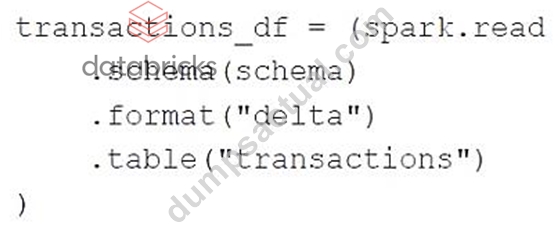
Which of the following changes needs to be made so this code block will work when the transactions table is a stream source?
- A. Replace schema(schema) with option ("maxFilesPerTrigger", 1)
- B. Replace spark.read with spark.readStream
- C. Replace "transactions" with the path to the location of the Delta table
- D. Replace format("delta") with format("stream")
- E. Replace predict with a stream-friendly prediction function
Answer: B
Explanation:
To read from a stream source, the data engineer needs to use the spark.readStream method instead of the spark.read method. The spark.readStream method returns a DataStreamReader object that can be used to specify the details of the input source, such as the format, the schema, the path, and the options. The spark.read method is only suitable for batch processing, not streaming processing. The other changes are not necessary or correct for reading from a stream source. Reference: Structured Streaming Programming Guide, Read a stream, Databricks Data Sources
NEW QUESTION # 134
A data engineer is attempting to drop a Spark SQL table my_table and runs the following command:
DROP TABLE IF EXISTS my_table;
After running this command, the engineer notices that the data files and metadata files have been deleted from the file system.
Which of the following describes why all of these files were deleted?
- A. The table's data was smaller than 10 GB
- B. The table's data was larger than 10 GB
- C. The table was external
- D. The table was managed
- E. The table did not have a location
Answer: D
NEW QUESTION # 135
A data engineer wants to create a new table containing the names of customers that live in France.
They have written the following command:
A senior data engineer mentions that it is organization policy to include a table property indicating that the new table includes personally identifiable information (PII).
Which of the following lines of code fills in the above blank to successfully complete the task?
- A. COMMENT "Contains PII"
- B. PII
- C. There is no way to indicate whether a table contains PII.
- D. TBLPROPERTIES PII
- E. "COMMENT PII"
Answer: A
Explanation:
Explanation
Ref:https://www.databricks.com/discover/pages/data-quality-management
CREATE TABLE my_table (id INT COMMENT 'Unique Identification Number', name STRING COMMENT 'PII', age INT COMMENT 'PII') TBLPROPERTIES ('contains_pii'=True) COMMENT 'Contains PII';
NEW QUESTION # 136
......
New Databricks-Certified-Data-Engineer-Associate Exam Questions Real Databricks Dumps: https://exampdf.dumpsactual.com/Databricks-Certified-Data-Engineer-Associate-actualtests-dumps.html
