

[May 16, 2026] New InsuranceSuite-Developer Exam Dumps with High Passing Rate
Get InsuranceSuite-Developer Braindumps & InsuranceSuite-Developer Real Exam Questions
NEW QUESTION # 13
In the Extensions folder, there is a typelist file named BusinessType.ttx containing three typecodes: Insurer, Broker, and Agency. The business analysts have requested an additional typecode:Reinsurer. How should this typecode be added?
- A. Create a .ttx extension file and add a reinsurer_Ext typecode to it
- B. Create a reinsurer_Ext typecode in BusinessType.ttx
- C. Create a reinsurer typecode in BusinessType.ttx
- D. Create a Reinsurer_Ext typelist with a reinsurer typecode
Answer: C
Explanation:
When managingTypelists(Guidewire's version of enumerations) in a Cloud-compliant environment, there is a distinct difference between adding codes to an existing typelist and creating an entirely new one.
According to theInsuranceSuite Developer Fundamentalscurriculum, if you are adding a new code to an existingtypelist that is already an extension (indicated by the .ttx file extension), you simply add the new code to that existing .ttx file.
One of the most common points of confusion is the use of the _Ext suffix. Whilenew entitiesandnew typelists require the _Ext suffix to follow Cloud Delivery Standards,individual typecodes(the values within the list) generally donotrequire the suffix unless the specific project guidelines demand it for every single metadata element. In standard Guidewire practice, a typecode named reinsurer (Option B) is sufficient and cleaner.
Option C is incorrect because you should not create multiple .ttx files for the same typelist; you should consolidate extensions into the existing one. Option D is incorrect because it suggests creating a whole new list rather than modifying the existing one. Option A is less ideal because adding _Ext to individual codes within a list is not a mandatory platform requirement and can make logic like TC_REINSURER_EXT cumbersome to write in Gosu.
NEW QUESTION # 14
The company has requested to group 3 new Pages, within Claim Details, in the left navigation. Which configuration best practice should be used to implement this requirement?
- A. Configure the new Page navigations within the TabBar definition.
- B. Define the Page links in a reusable InputSet file to group the new pages.
- C. Use a MenuItemIterator widget to create the heading and organize the Page links.
- D. Implement each new Page as a LocationRef with its own Hyperlink widget.
- E. Configure a new LocationGroup to group the new pages.
Answer: E
Explanation:
The Guidewire UI is organized into a hierarchy ofLocations, and the primary mechanism for grouping related pages in the side navigation (the "sidebar" or "west panel") is theLocationGroup. When a business requirement calls for grouping multiple pages under a single heading-such as adding three specialized inquiry pages within the "Claim Details" area-a LocationGroup is the standard architectural choice.
A LocationGroup acts as a container for multiple LocationRef elements (which point to specific Pages, Worksheets, or other Groups). By defining a new LocationGroup (Option E), the developer can create a nested navigation structure. This results in a cleaner UI where a single parent entry in the sidebar can be expanded to reveal the three sub-pages. This follows the design pattern used throughout InsuranceSuite (for example, the "Financials" or "Parties Involved" sections in ClaimCenter).
Options A, B, and C are incorrect because they use the wrong widgets or locations for side-navigation logic.
TabBar (Option B) is for top-level application switching (like moving between Claim, Policy, and Desktop), not for internal page grouping. InputSet (Option C) is for grouping fields within a page, not for managing navigation locations. MenuItemIterator (Option D) is generally used for dynamic menu generation (like a list of recent claims) rather than static structural navigation. Using a LocationGroup ensures that the navigation remains declarative and consistent with the platform's breadcrumb and security permission logic.
NEW QUESTION # 15
An insurer would like to include the Law Firm Specialty as part of the Law Firm's name whenever the name is displayed in a single widget. Which configurations follow best practices to meet this requirement?
- A. Use a dynamic field to generate the display string to include the law firm's specialty.
- B. Place a Text Cell widget in the ListView's Row container for the law firm's specialty.
- C. Add a custom field to the entity to store a concatenated display string.
- D. Implement a getter method on the entity to return a formatted name that includes the law firm's specialty.
- E. Modify the Law Firm entity's displayname property to include the law firm's specialty.
- F. Configure the entity name for the Law Firm entity to include law firm's specialty.
- G. Place a Text Input widget in the ListView's Row container for the law firm's specialty.
Answer: F
NEW QUESTION # 16
A customer needs the ability to categorize claims based on business needs. Which actions below follow best practices? (Choose two)
- A. Add a 'foreignkey' to the ClaimCategory_Ext typelist that references the Claim entity
- B. Define ClaimCategory_Ext as an extension of an existing claim Typelist.
- C. Create a .tti file for ClaimCategory_Ext in the Extensions\Typelist folder
- D. Add a ClaimCategory_Ext Typekey to the Claim entity
- E. Create a .ttx file for ClaimCategory_Ext in the Extensions\Typelist folder
- F. Name the Typelist ClaimCategory without an _Ext suffix.
Answer: C,D
Explanation:
When extending the Guidewire Data Model to meet specific business requirements, such as categorizing a Claim, developers must follow strict metadata standards. The process of adding a new categorization tool involves two primary steps: defining the list of possible values (the Typelist) and then linking that list to the business entity (the Claim).
According to Guidewire best practices, when you create anewTypelist that is not part of the base configuration, you must define it using a.tti (Typelist Interface)file. This file acts as the primary definition for the new list. Per Guidewire naming conventions, custom extensions and new metadata objects should be suffixed with _Ext to clearly distinguish them from "Out of the Box" (OOTB) components. This ensures that during future upgrades, the Guidewire upgrade tools can easily identify and preserve customer-specific configurations. Therefore, creating a .tti file named ClaimCategory_Ext.tti (Option F) is the correct procedure for initializing a new list of categories.
Once the Typelist is defined, it must be associated with the Claim entity so that each claim record can hold a specific category value. This is done by adding a new field to the Claim entity. In Guidewire, a field that references a Typelist is known as atypekey. By adding a typekey field named ClaimCategory_Ext to the Claim entity (Option B) and pointing it to the newly created Typelist, the developer enables the database to store the category selection.
Options A and C are incorrect because .ttx files are used for extendingexistingbase typelists, not for creating entirely new ones. Option E violates the naming convention, and Option D describes a foreign key relationship which is technically different from the standard typekey implementation used for simple categorization via Typelists.
NEW QUESTION # 17
An insurance carrier needs the ability to capture information for different kinds of watercraft, such as power boats, personal water craft, sailboats, etc. The development team has created a Watercraft_Ext entity with subtype entities to store the distinct properties of each type of watercraft. Which represents the best approach to provide the ability to edit the data for watercraft in the User Interface?
- A. Create a Detail View for the common properties of all watercraft and a set of Modal InputSets for the distinct property of each watercraft
- B. Create a set of Modal Pages for each type of watercraft
- C. Create a Modal Detail View for each type of watercraft, duplicating common fields across each Detail View
- D. Create a single page for all watercraft types with the visibility of fields distinct to the type of watercraft controlled at the widget level
Answer: A
Explanation:
Guidewire configuration follows the principle ofModular UI Design, especially when dealing with entity inheritance (subtypes). In this scenario, the carrier has a base Watercraft_Ext entity with multiple subtypes (e.
g., PowerBoat, Sailboat). These subtypes share common attributes (like Make, Model, and Year) but have unique attributes (like MastHeight for sailboats or EngineType for powerboats).
The best practice for designing an interface for subtypes is to useModal InputSets(Option D). This approach involves creating a "master" Detail View (DV) that contains the common fields shared by all watercraft.
Below the common fields, a ModalInputSet is added. Guidewire's PCF engine then uses a "mode" (typically the subtype name) to determine which specific InputSet to render at runtime.
This method is superior to others for several reasons:
* Maintenance:Common fields are defined in only one place. If you need to add a "Color" field to all watercraft, you change one DV, not five separate pages (avoiding the redundancy of Option A).
* Performance and Cleanliness:It avoids a massive, cluttered page with hundreds of "visible" expressions (Option B), which is difficult to maintain and can slow down page rendering.
* User Experience:It provides a seamless experience where the UI dynamically adjusts to the specific boat type without the jarring transition of moving between entirely different pages (Option C).
By using InputSet widgets with the mode property, developers can create a highly scalable and organized UI that mirrors the object-oriented structure of the underlying Data Model.
NEW QUESTION # 18
The sources describe different types of deployment strategies for InsuranceSuite applications. What are characteristics of a selective deployment?
- A. It always involves a database restore from production.
- B. It is the only strategy that supports rolling updates.
- C. It is primarily used for deploying builds to production star systems.
- D. It requires deploying all InsuranceSuite and EnterpriseEngage applications simultaneously.
- E. It allows deployment of only the selected InsuranceSuite applications.
Answer: E
Explanation:
InGuidewire Cloud Platform (GWCP), deployment flexibility is key to managing complex multi- application environments. ASelective Deployment(Option E) is a strategy where a developer or release manager chooses to deploy a subset of the available applications rather than the entire suite.
For example, if a developer has only made configuration changes toPolicyCenterandContactManager, they can trigger a selective deployment for just those two applications while leavingClaimCenterandBillingCenter at their current versions. This is particularly useful in non-production environments (like Dev or QA) to speed up the build-and-deploy cycle and minimize disruption to other teams working on different applications.
Key characteristics include:
* Granular Control:You choose which specific components (e.g., PC, BC, CC, or Digital applications) are pushed.
* Environment Stability:It reduces the risk of side effects on applications that haven't changed.
* Pipeline Efficiency:Since fewer containers are being built and restarted, the overall deployment time is often shorter than a full suite deployment.
Option C describes the opposite (a Full Deployment). Option A is incorrect as production deployments typically follow a more rigid, all-inclusive "Release" structure to ensure synchronization. Option B is a data management task (masking/refreshing), which is distinct from the deployment of application code.
NEW QUESTION # 19
What are two types of Guidewire Profiler? (Select two)
- A. Database Performance
- B. Exit-point
- C. Worksheet
- D. Entry-point
Answer: C,D
Explanation:
TheGuidewire Profileris a powerful diagnostic tool used to analyze the performance of Gosu code, database queries, and rule execution within the application. It helps developers identify bottlenecks by providing a detailed breakdown of where time is being spent during a specific operation.
According to the "System Health & Quality" training, the Profiler is categorized based on how the profiling data is captured and viewed. The two primary types areEntry-pointandWorksheet.
* Entry-point Profiler (Option B):This is used to profile a specific "entry point" into the application, such as a Web Service call, a Batch Process, or a specific PCF Page load. When a developer enables an entry-point profiler, the system records every operation (Gosu execution, SQL query, etc.) that occurs from the moment the entry point is triggered until it completes. This is essential for diagnosing high- latency API calls or slow-running background tasks.
* Worksheet Profiler (Option D):This type is accessible directly within the application UI via the
"Worksheet" (the slide-up panel at the bottom). It allows a developer or tester to profile their own current session. By clicking "Enable Profiler" in the worksheet, the developer can perform a specific action (like clicking a button or saving a claim) and immediately view the performance trace once the action finishes.
Options A (Exit-point) and C (Database Performance) are not standard names for the Profiler types in Guidewire. While the Profilermeasuresdatabase performance, it is not a "type" of Profiler itself.
Understanding the difference between these types allows developers to choose the right diagnostic tool depending on whether they are troubleshooting a user-interface issue (Worksheet) or a systemic back-end performance problem (Entry-point).
NEW QUESTION # 20
Succeed Insurance needs to implement a number of Gosu functions. Select the options that follow best practices. Select Two
- A. Functions defined in a Gosu class should be named in upper camel case such as ModifyAddressInformation
- B. When implementing an interface such as Rental Location the class should be called RentalLocationImpl.
- C. Add new interfaces to a customer package space such as si. in this case. In addition, do not append _Ext on the interface name in this package.
- D. When writing UI related functions, that code should be placed in the code tab of a PCF file to improve performance and maintainability.
- E. Entities should be extended to support UI operations. Following this practice ensures easier maintainability by developers.
- F. When writing UI related functions, that code should be placed in UI helper classes. Following this practice ensures easier maintainability by developers.
- G. Use underscores to separate words in function names for better readability.
Answer: C,F
Explanation:
In Guidewire development, code organization is paramount for maintainability and scalability. According to the Gosu best practices taught in theInsuranceSuite Developer Fundamentalscourse, UI-related logic should be separated from the visual definition of the page. While PCF files have a "Code" tab, placing extensive logic there (Option E) is considered a "coding anti-pattern." Instead, developers should createUI helper classes(Option A). This separation of concerns allows for easier unit testing of the logic and ensures that the PCF files remain focused on UI layout and widget configuration.
Furthermore, when introducing custom architectural components likeinterfaces, developers must manage namespaces correctly to ensure upgrade safety. If a developer creates a new interface within a dedicated customer package-such as si.insurance.util-Guidewire best practices (Option D) state that the _Ext suffix is not strictly required on the interface name itself because the package name already distinguishes it as a custom component. This differs from entity extensions where the suffix is mandatory because entities share a global namespace.
Options B and F violate standard Gosu naming conventions. Gosu methods should uselower camelCase(e.g., modifyAddressInformation), and while Impl is a common Java pattern, Guidewire prefers more descriptive naming or standard package-based organization. Option C is incorrect because entities should ideally contain business logic related to the data itself, not specific UI state or manipulation logic, which is better handled in helper classes.
NEW QUESTION # 21
An insurer plans to offer coverage for pets on homeowners policies. Whenever the covered pet Is displayed in the user interface, it should consist of the pet's name and breed. For example:
How can a developer satisfy this requirement following best practices?
- A. Define an entity name that concatenates the pet's name and breed fields
- B. Create a setter property in a Pet enhancement class
- C. Enable Post On Change for the pet name field to modify how it displays when referenced
- D. Create a display key that concatenates the pet's name and breed
Answer: A
Explanation:
InGuidewire InsuranceSuite, the global representation of a data object in the user interface is controlled by itsEntity Nameconfiguration. This configuration, stored in .en files within the metadata, defines how an instance of an entity is converted into a string whenever it is referenced in a widget like a RangeInput (dropdown), a TextCell in a list, or a read-only view.
According to theInsuranceSuite Developer Fundamentalscourse, the best practice for a requirement that applies "whenever the entity is displayed" is todefine an Entity Name(Option B). This approach allows the developer to specify a template-often involving multiple fields-that the application server uses automatically. In this scenario, the developer would configure the Pet_Ext entity name to return a string like this.Name + " - " + this.Breed.
This method is superior to other options for several reasons:
* Centralization:You define the display logic once. If the business later decides to include the pet's age or color, you only update the .en file, and the change propagates across the entire application instantly.
* Performance:The Guidewire platform caches these display names efficiently. Using logic in every PCF (Option A) or creating manual display keys (Option D) increases the maintenance burden and can lead to inconsistent UI if a developer misses a specific screen.
* Declarative Nature:It follows the Guidewire philosophy of using metadata for structural and identity- related logic, keeping Gosu code reserved for complex business processes.
Options likePost On Change(Option A) are designed for UI refreshes and cannot change the underlying string representation of an object. ASetter(Option C) is used for writing data to the database and is irrelevant to how data is formatted for viewing.
NEW QUESTION # 22
Which GUnit base class is used for tests that involve Gosu queries in PolicyCenter?
- A. SuiteDBTestClassBase
- B. PCUnitTestClassBase
- C. PCServerTestClassBase
- D. GUnitTestClassBase
Answer: C
Explanation:
In theGuidewire System Health & Qualitytraining, understanding the hierarchy of GUnit base classes is essential for writing effective automated tests.
While GUnitTestClassBase (Option A) provides basic testing functionality, it does not necessarily initialize the full application server environment or the database connection required for complex operations. For tests that require thefull Guidewire stack-including the ability to executeGosu queriesagainst the database or interact with the bundle-developers must usePCServerTestClassBase(Option D) in PolicyCenter (or CCServerTestClassBase in ClaimCenter).
This base class ensures that:
* The Guidewire Application Server environment is "mocked" or started.
* The current user session is authenticated.
* The database transaction manager (Bundles) is available for queries and commits.
Using a lower-level base class for a query-based test would result in a NullPointerException or a NoSessionException because the Query API requires an active server context to translate Gosu into SQL.
NEW QUESTION # 23
Business analysts have provided a requirement to store contacts' usernames in the Click-Clack social media website in a single field on the Contact entity. Which solution follows best practices and fulfills the requirement?
- A. Extend the Contact entity with a field named ClickClack_Ext of type addressline
- B. Extend the Contact entity with a field named ClickClack_Ext of type shorttext
- C. Extend the Contact entity with a field named ClickClack of type shorttext
- D. Extend the Contact entity with a field named ClickClack of type blob
Answer: B
Explanation:
InGuidewire InsuranceSuite, extending the data model to accommodate custom business requirements must follow strict architectural standards to ensure the application remains upgradeable and compliant withCloud Delivery Standards.
1. The Importance of the Naming Suffix (The _Ext rule)
The primary rule in Guidewire configuration is that any customer-added element (entities, fields, or typelists) mustbe suffixed with_Ext. As specified in theInsuranceSuite Developer Fundamentalscourse, this suffix serves as a "namespace" that prevents naming collisions with future base-product updates provided by Guidewire. If you were to name a field simply ClickClack (as in Options B and C), and a future Guidewire update introduced a field with the exact same name, the application server would fail to start due to metadata conflict. Therefore, the field must be named ClickClack_Ext.
2. Selecting the Correct Data Type
For a social media username, the developer must choose the most efficient and semantically appropriate data type.
* shorttext (Option D):This is the standard type for strings up to 60 characters. It is the most appropriate for a username, as it is indexed efficiently by the database and provides enough space for almost any social media handle.
* addressline (Option A):While this is also a string type (typically 60 characters), it is semantically intended for physical street addresses. Using it for social media handles is poor practice as it makes the metadata confusing for other developers.
* blob (Option B):This is used for "Binary Large Objects," such as images or documents. Using a blob for a simple text username would cause massive performance issues during searches and consume unnecessary database storage.
By choosingOption D, the developer ensures that the field is clearly identified as a custom extension and uses the most performant data type for the specific information being stored. This follows the "KISS" (Keep It Simple, Stupid) principle and Guidewire's automated quality gates for Cloud deployments.
NEW QUESTION # 24
ABPersonVendor is an entity in the base application. An insurer needs to add a new person vendor type for auditors. Which configuration fulfills the requirement and follows the best practices?
- A. Create ABAuditor_Ext.eti with a foreign key pointing to ABPersonVendor
- B. Add a new entity ABAuditor_Ext.eti as a subtype of ABPersonVendor
- C. Create ABAuditor.etx as an extension of ABPersonVendor
- D. Add a new column Auditor_Ext in the entity extension ABPersonVendor.etx
Answer: B
Explanation:
In the Guidewire Data Model, representing specialized versions of existing objects is handled throughEntity Inheritance (Subtyping). In this scenario, an "Auditor" is a specific type of "Person Vendor." While they likely share the core attributes of a person vendor (name, tax ID, address), they may have specific requirements or behaviors unique to their role.
According to Guidewire best practices, when you need to create a specialized category of a base entity that requires its own distinct identity or specific additional fields, you should create aSubtype. Option B is the correct implementation: creating ABAuditor_Ext.eti and defining its supertype as ABPersonVendor. This allows the Auditor to inherit all fields, arrays, and foreign keys from the parent vendor entity while allowing the developer to add auditor-specific logic. The use of the .eti extension is correct for defining the new subtype entity, and the _Ext suffix follows the mandatory naming convention for custom extensions.
Option A (adding a column) is less flexible because it doesn't allow for the object-oriented benefits of subtyping, such as specific type-checking in Gosu. Option C (foreign key) creates a "Has-A" relationship rather than an "Is-A" relationship, which complicates the data model and UI logic. Option D is incorrect because an .etx file is used to add fields to anexistingentity, not to define a new specialized entity type.
Subtyping ensures that the "Auditor" can be used anywhere a "Person Vendor" is expected, providing clean, polymorphic behavior across the InsuranceSuite applications.
NEW QUESTION # 25
ContactManager provides an inline reference to an editable list view on the Contact Basics screen that supports adding and editing of banking information for contacts. The screenshot below shows this list view in Studio. There is an error within the red outline.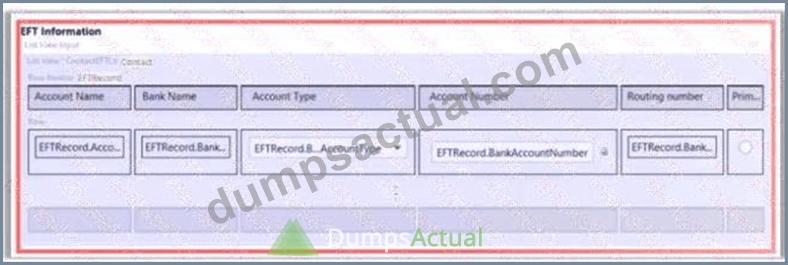
Which configuration changes are necessary to resolve the error? (Select two)
- A. Add edit permissions to the row iterator
- B. Add a toolbar widget to the list view input
- C. Replace the list view input with a panel ref
- D. Replace the list view PCF with an inline list view
- E. Add and configure Iterator buttons
Answer: B,E
Explanation:
In the GuidewirePage Configuration Framework (PCF), displaying a list of data within aDetail View (DV) requires specific container widgets. When a developer uses aListViewInputto embed an existing List View into a form, they are essentially creating an "editable grid" section.
1. The Requirement for a Toolbar (Option A)
According to theInsuranceSuite Developer Fundamentalsguide, a ListViewInput is a specialized widget that acts as a wrapper for a List View. Unlike a standard List View displayed on its own page (which inherits the page's toolbar), a ListViewInput exists inside a Detail View column. For the list to be interactive- allowing users to add new bank accounts or remove existing ones-the ListViewInputmust have its own Toolbar. In Guidewire Studio, if a ListViewInput is marked as editable but lacks a toolbar, the metadata validator will flag an error because there is no container to hold the necessary action buttons.
2. Configuring Iterator Buttons (Option B)
Once the Toolbar is added to the ListViewInput, it remains empty untilIterator Buttonsare placed inside it.
These buttons (typically the "Add" and "Remove" buttons) must be explicitly configured to point to theRow Iteratordefined within the referenced List View PCF.
The error in the screenshot is resolved by:
* Selecting the ListViewInput in the PCF tree.
* Adding aToolbarchild widget.
* AddingIterator Buttons(Add/Remove) to that toolbar.
* Linking those buttons to the correct iterator ID.
This combination provides the end-user with the UI controls needed to manipulate the banking information array. Options C and D represent alternative ways to structure the UI but do not address the specific configuration error of the ListViewInput widget. Option E relates to security and runtime behavior, not the structural metadata requirements of the PCF layout engine.
NEW QUESTION # 26
Which uses correct Gosu syntax and follows Gosu best practices?
- A. myValue == true and !(boolValue)
- B. myCollection.Count > 0 and myValue == true
- C. myNumber is greater than 10 and myNumber is less than 20
- D. myValue == true ? null : <error message>
- E. myString.IsNullOrEmpty() or myNumber == 0
Answer: C
Explanation:
Guidewire'sGosulanguage is designed to be highly readable and "English-like," which helps bridge the gap between business analysts and developers. While Gosu supports standard Java-style operators (like &&, ||, and ==), thebest practiceis to use Gosu's uniquereadable operators.
Option E is the correct choice because it uses the readable keywordsis greater thanandis less than. In Guidewire development, this is preferred over > and < because it improves the maintainability of complex business rules and makes the code more accessible to non-technical stakeholders.
Why other options are considered less ideal or incorrect:
* Option A:Uses a ternary operator which is often discouraged in simple business rules in favor of clear if
/else statements for better readability.
* Option B:Redundancy. In Gosu, you should never write == true. You should simply write if (myValue).
* Option C:While .IsNullOrEmpty() is a valid enhancement, the use of the or keyword is correct, but Option E is a "purer" example of Gosu-specific best practices regarding numeric comparisons.
* Option D:Redundancy again with == true, and .Count can be inefficient on large collections compared to .HasElements.
By using the syntax inOption E, developers follow the "Gosu way" of writing clear, expressive, and self- documenting code.
NEW QUESTION # 27
Which logging statement follows best practice?
- A. If(_logger.DebugEnabled) { _logger.debug(logPrefix + someReallyExpensiveOperation()) }
- B. If(_logger.InfoEnabled) { _logger.debug("Adding '${contact.PublicID}' to ContactManager") }
- C. _logger.error(DisplayKey.get("Web.ContactManager.Error.GeneralException", e.Message))
- D. _logger.info(logPrefix + "[Address#AddressLine1=" + address.AddressLine1 + "] [Address#City" + address.City + "] [Address#State" + address.State + "]")
Answer: A
Explanation:
Logging efficiency is a critical component of Guidewire application performance. In a production environment, logging levels are typically set to INFO or WARN. However, developers often include DEBUG level logs to assist with troubleshooting. The primary performance risk occurs when a log statement requires significant computational resources to construct the message string-such as calling a method that performs complex calculations or database lookups-even when the log level is currently disabled.
Option C follows the absolute best practice by wrapping the log call in anIsDebugEnabledcheck. This ensures that the someReallyExpensiveOperation() method is only executed if the system is actually configured to record debug logs. Without this check, the application would waste CPU cycles performing the
"expensive operation" only to have the logger discard the resulting string because the level was set to INFO.
Other options fail for various reasons: Option A incorrectly checks InfoEnabled before calling debug, which is a logical mismatch. Option B is risky because passing raw exception messages (e.Message) into a display key can lead to inconsistent formatting or potential security issues if the message is shown to users. Option D demonstrates "Chatty Logging" and string concatenation without a level check, which can negatively impact performance and clutter log files with non-essential state data. Guidewire's logging framework (built on Log4J
/SLF4J principles) thrives when developers use guards like DebugEnabled to protect system resources.
NEW QUESTION # 28
As a developer you are creating a new Gosu class for Succeed Insurance. According to the course material, which of the following statements define how you should implement logging in your new class? (Choose Two)
- A. All exceptions are errors, thus they should always be logged at the error level.
- B. Logging in the cloud can be provided in either a string format or JSON.
- C. When logging an exception, provide details about the cause of the exception. Because you are providing a detailed description there is no need to log the exception message or stack trace.
- D. When logging Personal Identifiable Information (Pll), developers should log the information at least at the INFO level.
- E. Providing context when logging errors is essential. However, developers should avoid excessive logging, as it can be costly to implement and maintain, and it may negatively impact performance.
- F. Checking the log level before logging is usually unnecessary, as logging typically has minimal impact on performance.
- G. When logging at the debug level you should check to see if debugging in enabled first to minimize possible performance issues.
Answer: E,G
Explanation:
In Guidewire development, logging is a critical tool for troubleshooting and monitoring, but it must be implemented with a focus on system performance and security. According to the Guidewire InsuranceSuite Developer guidelines, "excessive logging" is a common source of performance degradation. Developers are instructed to provide meaningful context for errors so that support teams can diagnose issues without needing to reproduce them manually. However, logging should be used judiciously; logging too much data (Option D) increases I/O overhead and can clutter logs, making it difficult to find relevant information.
A specific best practice highlighted in the course material involves the use of theDebuglog level. Because debug messages often involve complex string concatenation or data retrieval that consumes CPU cycles, developers should wrap these calls in a conditional check. By using if (logger.isDebugEnabled()) (Option C), the system avoids the cost of constructing the log message entirely if the current logging level is set to a higher priority, such as INFO or WARN. This practice is essential for maintaining high throughput in a production environment where debug logging is typically disabled.
Other options provided are contrary to Guidewire standards. For instance,Personal Identifiable Information (PII)(Option F) shouldneverbe logged in plain text due to data privacy regulations (GDPR/CCPA), and logging it at an INFO level would be a major security violation. Furthermore, while exceptions should be logged, not all exceptions are errors (some are expected business logic flows), and when they are logged, the stack trace is vital for debugging (refuting Option B). Guidewire Cloud primarily standardizes on structured logging (JSON) for observability, but the fundamental developer best practices regarding performance (C and D) remain the primary focus of the Fundamentals course.
NEW QUESTION # 29
An insurance carrier plans to launch a new product for various types of Recreational Vehicles (RVs)-such as motorhomes, boats, motorcycles, and jet skis. When collecting information to quote a policy, all RVs share some common details (like purchase date, price, year, make, and model), but each type also has its own unique properties. According to best practices, what should be done to configure the User Interface so that only the relevant RV details are shown when creating a policy quote? Select Two
- A. Define a Location Group to allow the user to choose the page for each RV type.
- B. Place an Input Set Ref on the Detail View and configure the RV type as the Mode.
- C. Create separate inline Input Sets for each RV type and set the visibility on each Input Set
- D. Create a Modal Input Set for each RV type.
- E. Create a separate page for each type of RV.
- F. Create a Detail View that includes the properties that are common to all of the RV types.
Answer: B,F
Explanation:
In the Guidewire Page Configuration Framework (PCF), the primary goal for handling polymorphic data- such as a base Recreational Vehicle entity with various subtypes-is to maximize code reuse while providing a dynamic user experience. According to theInsuranceSuite Developer Fundamentalscourse, the best practice for this scenario involves a "Master-Detail" design pattern utilizingModal PCFs.
The first step (Option D) is to create a primaryDetail View (DV). This DV acts as the foundation for the UI and contains all the fields that are shared across all RV types, such as PurchaseDate, Price, and Model. By centralizing these common fields, the developer ensures that any global changes to RV data (like adding a
"Condition" field) only need to be made in one place, rather than across multiple fragmented pages.
The second step (Option E) addresses the unique properties of each RV type. Rather than cluttering the main DV with every possible field and using complex "visible" expressions (which is what Option C suggests and is discouraged due to performance and maintenance overhead), developers should use anInput Set Refwith theModeproperty set. Each specific RV type (e.g., Boat, Motorcycle) has its own separate Input Set. At runtime, the Guidewire application looks at the RV type of the current object and automatically renders the corresponding Input Set. This "Modal" approach is the standard architectural way to handle subtypes in PolicyCenter and ClaimCenter. Options A, B, and F are incorrect because they either introduce unnecessary navigation complexity or fail to leverage the built-in dynamic rendering capabilities of the PCF framework.
NEW QUESTION # 30
A business analyst has a new requirement for an additional filter on Desktop Activities. Which two options can be used to filter a query-backed ListView? (Select two)
- A. Use a Gosu standard query filter in the filter property of a ToolbarFilterOption of a ToolbarFilter widget
- B. Create an array of filtered values to populate the ListView
- C. Use a Gosu standard bean filter in the filter property of a ToolbarFilterOption
- D. Add a ToolbarFilterOption to the ToolbarFilter widget
- E. Create a Gosu method to loop through the ListView rows adding the rows that match the criteria
Answer: A,D
Explanation:
In Guidewire PCF development, filtering aquery-backed ListView(one that uses a QueryProcessor) must be done efficiently to avoid loading thousands of records into memory. According to theInsuranceSuite Developer Fundamentalscourse, the standard tool for this is theToolbarFilterwidget.
AToolbarFilteracts as a container for one or moreToolbarFilterOptionwidgets (Option C). Each option represents a choice in the dropdown menu for the user. To ensure performance, specifically for query-backed lists, the developer should use aGosu standard query filter(Option B) in the filter property. Unlike a "bean filter," which filters objects already in memory, a query filter allows the Guidewire platform to modify the underlying SQL statement. This ensures that only the records matching the selected filter are ever retrieved from the database, significantly reducing the application server's load.
Options D and E are "anti-patterns." Manual looping or creating custom arrays bypasses the optimized Query API, leading to "OutOfMemory" errors or severe performance degradation when dealing with large volumes of data, such as an insurer's entire set of desktop activities.
NEW QUESTION # 31
Which statement is correct and recommended for writing GUnit tests?
- A. Use the init() method to set up objects shared by all tests in a test class
- B. Handle any exceptions thrown by test methods in the finally() method
- C. Use fluent assertions over conventional assert statements
- D. Clear all instance variables of completed test in the tearDown() method
Answer: A
Explanation:
GUnitis the Guidewire-specific testing framework based on JUnit, used to verify that Gosu classes and business rules function correctly. Efficient test writing requires a clear understanding of the test lifecycle, specifically how to manage resources and test data.
According to the Guidewire "System Health & Quality" training, theinit()method (or equivalent
@BeforeClass setup logic in newer versions) is the recommended location for initializing resources that are expensive to create or are shared across all test methods within a specific class (Option A). By setting up shared objects-such as mock configuration data or static helper instances-in the init() phase, the developer ensures that the test suite runs faster and avoids redundant processing for every individual test case.
While Option C (clearing variables in tearDown()) is a valid memory management practice in some long- running Java environments, the primary focus of Guidewire GUnit training regarding the test lifecycle emphasizes thesetupphase to ensure a consistent "known state" before tests execute. Option B is incorrect because GUnit is designed to catch and report exceptions as test failures; wrapping them in a manual finally block would obscure the failure and bypass the framework's reporting capabilities. Option D mentions fluent assertions; while modern and readable, conventional assertTrue, assertEquals, and assertNotNull remain the standard recommended assertion types in the core Guidewire Developer training curriculum.
NEW QUESTION # 32
There is a requirement to add fields specific to Auto Rental Agencies. The additional fields required are; Auto Renta License, Offers Roadside Assistance, and Offers Insurance. Other fields will come from the existing ABCompanyVendor entity.
For reference, the diagram below shows the ABCompany subtype of the ABContact entity: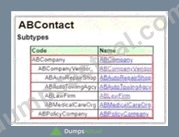
How should this requirement be configured following best practices?
- A. Create a custom entity ABAutoRentalAgency_Ext and add the three fields to this entity
- B. Create ABAutoRentalAgency.Ext as a subtype of A B Company Vendor and add the three fields to the subtype
- C. Create three new fields to extend the existing ABCompany Vendor subtype
- D. Create ABAutoRentalAgency.Ext as a subtype of ABCompany and add the three fields to the subtype
Answer: B
Explanation:
In the Guidewire Data Model, managing entity relationships through Subtyping is a core principle for maintaining a clean, performant, and logically structured database. According to the InsuranceSuite Developer Fundamentals course, subtyping should be used when a specific group of entities shares a common base but requires additional, unique attributes.
1. Leveraging the Existing Hierarchy
The prompt specifies that "other fields will come from the existing ABCompanyVendor entity." In the Guidewire ContactManager (AB) data model, the hierarchy typically flows from ABContact # ABCompany # ABCompanyVendor. By creating ABAutoRentalAgency_Ext as a subtype of ABCompanyVendor (Option A), the new entity automatically inherits all properties from the vendor level (such as Tax ID or Vendor Number) and the company level (such as Name or Address). This maximizes code and metadata reuse.
2. Why Subtyping is Better than Extension
If a developer were to follow Option D and add these three fields directly to ABCompanyVendor, every vendor in the system-including Law Firms, Doctors, and Repair Shops-would have fields for "Auto Rental License." This is known as "data model pollution." It makes the database tables wider than necessary and complicates the UI, as you would need complex "visible" expressions to hide these irrelevant fields for other vendor types.
By creating a specific subtype, Guidewire's Table-per-Subtype or Table-per-Hierarchy (depending on version and configuration) storage strategy ensures that these three specific fields are only relevant to Auto Rental Agency records. This keeps the data model logically distinct and allows for the use of Modal PCFs, where the UI automatically switches to display the correct fields based on the subtype of the contact being viewed.
Best Practice Summary: Use the _Ext suffix for the new subtype to follow Cloud Delivery Standards and place it as deep in the existing hierarchy as possible to inherit the most relevant specialized fields.
NEW QUESTION # 33
......
InsuranceSuite-Developer Dumps To Pass Guidewire Exam in 24 Hours - DumpsActual: https://exampdf.dumpsactual.com/InsuranceSuite-Developer-actualtests-dumps.html
