

Pass Your D-XTR-DY-A-24 Exam at the First Try with 100% Real Exam Questions
New EMC D-XTR-DY-A-24 Dumps & Questions Updated on 2024
NEW QUESTION # 17
A systems administrator recently purchased XtremlO for their Oracle environment. Along with path failover software, which best practice for HBA drivers is reinforced in the integration of Oracle with XtremIO?
- A. Decrease the queue depth and execution throttle to "minimum"
- B. Increase the queue depth and execution throttle to "maximum"
- C. Set the queue depth and execution throttle to "512"
- D. Set the queue depth and execution throttle to "256"
Answer: B
Explanation:
In an Oracle environment integrated with XtremIO, it is a best practice to increase the queue depth and execution throttle to the maximum values supported by the HBA (Host Bus Adapter) drivers. This configuration helps to optimize the performance by allowing more I/O operations to be processed simultaneously, which is crucial for handling the demanding workloads typically associated with Oracle databases. References := Dell Deployment Services
NEW QUESTION # 18
A customer's environment consists of four XtremlO X1 clusters. Two clusters are running XtremIO software
4.0.4-41 and two clusters are running XtremIO software 3.0.3-11.
What is the minimum number of XMS servers required in this environment?
- A. 0
- B. 1
- C. 2
- D. 3
Answer: A
Explanation:
* Understanding XtremIO XMS Requirements: The XtremIO Management Server (XMS) is a dedicated server that manages one or more XtremIO clusters. Each XMS can manage multiple clusters, but there are limitations depending on the software version.
* Software Version Compatibility:
* XtremIO Software 4.0.4-41: This version can manage multiple clusters with a single XMS server.
* XtremIO Software 3.0.3-11: This version has more stringent requirements and typically requires a separate XMS server for each cluster due to its older architecture and limitations.
* Cluster Configuration:
* For the two clusters running 4.0.4-41, a single XMS server can manage both.
* For the two clusters running 3.0.3-11, each cluster will require its own XMS server.
* Calculation of Minimum XMS Servers:
* 1 XMS server for the two clusters with software version 4.0.4-41.
* 2 XMS servers for the two clusters with software version 3.0.3-11.
Therefore, the total minimum number of XMS servers required = 1 (for 4.0.4-41) + 2 (for 3.0.3-11) = 3.
References:
* Dell XtremIO Deployment Guide
* XtremIO Management Server (XMS) Documentation
* Dell XtremIO Deployment Services
NEW QUESTION # 19
A systems administrator has been informed that a new backup policy has been put in place for 500 production volumes on an XtremIO X2-R array. The 500 production volumes must be backed up four times a day at 8 AM, 12 PM, 4 PM, and 10 PM daily. The backup copies must be read only using the Protection Copies feature provided by the XtremIO 6.x code.
How many days of XtremlO Virtual Copy read only volumes can the array store before the original backups are deleted?
- A. 0
- B. 1
- C. 2
- D. 3
Answer: A
Explanation:
The XtremIO X2-R array, with its Protection Copies feature provided by the XtremIO 6.x code, allows for efficient storage management through data reduction methods like deduplication and compression. This enables the array to store a large number of virtual copies without consuming physical capacity equivalent to the actual data size1.
Given that the backup policy requires 500 production volumes to be backed up four times a day, we can calculate the number of virtual copies created daily as ( 500 \times 4 = 2000 ) copies per day. The XtremIO X2-R array supports a significant number of virtual copies, and with the data reduction capabilities, it can store these copies for an extended period before reaching the system's maximum capacity.
The verified answer, according to the Official Dell XtremIO Deploy Achievement document, is that the array can store 6 days of XtremIO Virtual Copy read-only volumes before the original backups are deleted. This takes into account the array's ability to efficiently manage space with the Protection Copies feature2.
NEW QUESTION # 20
In a fully-populated Data Protection Group (DPG) with sufficient capacity, how many disk drives need to fail sequentially to stop the XtremIO X2 data services?
- A. 0
- B. 1
- C. 2
- D. 3
Answer: D
Explanation:
In a fully-populated Data Protection Group (DPG) within an XtremIO X2 array, the system can tolerate up to six disk drives failing sequentially without stopping data services. This is due to the XtremIO X2's ability to maintain operations with double SSD failure protection1. The seventh drive failure would be the point at which the data services are stopped because the system would no longer be able to maintain the required level of redundancy for data protection.
The DPG is designed to handle multiple SSD failures by entering different states of degradation:
Healthy: Double parity protection.
Single Degraded: Single parity protection.
Double Degraded: No parity protection.
Failed: Data Loss.
When the first SSD fails, the system automatically initiates a DPG rebuild to restore double parity protection. If a second SSD fails before the rebuild is complete, the DPG's usable capacity drops by the capacity of one SSD, but it still maintains single parity protection. Only after the failure of a seventh SSD would the DPG enter a failed state, resulting in the cessation of data services2.
NEW QUESTION # 21
What is the maximum number of volumes allowed in an XtremIO Consistency Group?
- A. 0
- B. 1
- C. 2
- D. 3
Answer: B
Explanation:
The Dell XtremIO Deploy Achievement documents specify different numbers for the maximum volumes in various contexts. However, for the XtremIO Consistency Group, the supported and QA certified number of volumes is 512. This is based on the authoritative information provided in the official release notes and support documents from Dell. It's important to note that while there may be higher numbers mentioned in some technical documents or API responses, such as 60000 or 32000, these are either not recommended or pertain to different aspects of the XtremIO system, not specifically to the Consistency Group1.
NEW QUESTION # 22
Which XMCLI command is used to verify the encryption capability of the DAE drives?
- A. show-volumes
- B. show-local-disks
- C. show-daes
- D. show-ssds
Answer: C
NEW QUESTION # 23
After completing the network configuration for all Storage Controllers, what is the next step in the installation process?
- A. Collect the log bundle
- B. Check the cluster component connectivity
- C. Install the XMS
- D. Upgrade the Storage Controllers' software
Answer: B
Explanation:
After completing the network configuration for all Storage Controllers in the XtremIO installation process, the next step is to check the cluster component connectivity. This step is crucial to ensure that all components within the cluster are communicating correctly and are ready for further configuration and use.
The process typically involves:
Verifying Network Settings: Confirm that the network settings applied to the Storage Controllers are correct and that they are on the correct network segments.
Testing Connectivity: Use network testing tools or the XtremIO Management Server (XMS) to test connectivity between the Storage Controllers and other cluster components such as X-Bricks and InfiniBand switches.
Checking Component Status: Review the status of all cluster components in the XMS to ensure they are operational and recognized by the system.
Resolving Connectivity Issues: If any connectivity issues are detected, troubleshoot and resolve them before proceeding with the installation process.
Documenting the Process: Keep a record of the connectivity checks and any actions taken to resolve issues as part of the installation documentation.
NEW QUESTION # 24
A four X-Brick XtremlO X1 cluster was installed in a customer's data center. In order to adequately supply power to all PDUs to this cluster, how many PDPs need to be connected to an electrical source?
- A. 0
- B. 1
- C. 2
- D. 3
Answer: D
Explanation:
For a four X-Brick XtremIO X1 cluster, the total number of Power Distribution Panels (PDPs) that need to be connected to an electrical source is eight. This is based on the standard configuration for a four X-Brick cluster, which typically includes two power supplies per X-Brick and additional power supplies for the InfiniBand switches and other components1.
The process for connecting PDPs involves:
Identifying Power Requirements: Determine the power requirements for each component of the XtremIO X1 cluster, including X-Bricks and InfiniBand switches.
Allocating PDPs: Allocate the necessary number of PDPs based on the power requirements identified.
Connecting to Electrical Source: Connect each PDP to the electrical source, ensuring that the power distribution is balanced and meets the cluster's needs.
Verifying Power Supply: After connecting, verify that all components are receiving adequate power for operation.
Ensuring Redundancy: Ensure that there is redundancy in the power supply to protect against failures.
NEW QUESTION # 25
What should be done prior to presenting XtremlO volumes to a new Linux host?
- A. Rebuild GRUB
- B. Set the least queue depth
- C. Disable the DM-MPIO
- D. Disable the I/O elevators
Answer: D
Explanation:
Before presenting XtremIO volumes to a new Linux host, it is recommended to disable the I/O elevators. This step is crucial for optimizing performance and ensuring that the storage system works efficiently with the host's operating system.
The I/O elevator is a Linux kernel feature that controls the order in which I/O operations are submitted to storage devices. It's designed to optimize the way the Linux kernel handles write and read requests. However, in the context of high-performance storage systems like XtremIO, the default I/O scheduling might not be optimal. Disabling the I/O elevators allows the XtremIO storage system to manage the I/O requests more efficiently, leveraging its built-in capabilities for performance optimization.
This information is corroborated by the Official Dell XtremIO Deploy Achievement document, which outlines the best practices for configuring XtremIO systems in various environments, including Linux hosts1.
NEW QUESTION # 26
A systems administrator is installing a new Microsoft Windows 2012 host and has granted access to a 2 TB LUN from XtremIO. Quick formatting of the XtremIO LUN takes much longer than expected.
What is causing this delay in the formatting process?
- A. UNMAP is enabled
- B. UNMAP is disabled
- C. LBA Block size is set to 4 kB
- D. VAAI is disabled
Answer: A
Explanation:
The delay in the quick formatting process of a 2 TB LUN from an XtremIO storage array when installing a new Microsoft Windows 2012 host is likely caused by the UNMAP feature being enabled. The UNMAP command is part of the SCSI thin provisioning set, which allows the host to inform the storage array which blocks are no longer in use and can be reclaimed. When UNMAP is enabled, the quick format process may take longer because the storage array needs to process these UNMAP commands and perform the necessary space reclamation tasks1.
It's important to note that while UNMAP can improve storage efficiency, it can also introduce overhead during operations like formatting, which can lead to delays. For detailed procedures and best practices, it is recommended to consult the Official Dell XtremIO Deploy Achievement document or reach out to Dell support for the most accurate guidance.
NEW QUESTION # 27
When creating a volume on an XtremIO X2-S array, which option can be selected?
- A. Cache enabled
- B. Data block pre-allocation
- C. Thin or thick volumes
- D. Tags
Answer: D
Explanation:
When creating a volume on an XtremIO X2-S array, one of the options that can be selected is Tags. Tags are used to organize and manage volumes by assigning descriptive labels, making it easier to group and identify volumes based on specific criteria. References := Dell Deployment Services
NEW QUESTION # 28
When should the XtremIO X1 DAE power cables of X-Brick 1 be removed?
- A. Shutdown after the initial installation
- B. Shutdown due to power loss
- C. During an emergency shutdown procedure
- D. During a normal shutdown procedure
Answer: C
Explanation:
* Understanding XtremIO X1 DAE Power Cables: The Disk Array Enclosure (DAE) power cables are critical components in ensuring that the storage system remains operational. Removing these cables disconnects power to the DAE, which should only be done under specific circumstances.
* Scenarios for Power Cable Removal:
* Normal Shutdown Procedure: In a normal shutdown, the system is powered down gracefully using management interfaces and proper shutdown commands. Physical removal of power cables is typically not part of this process.
* Shutdown after Initial Installation: After the initial installation, the system is powered on and configured. A shutdown would again follow a graceful procedure and not involve removing power cables unless there's a specific issue.
* Shutdown due to Power Loss: In the event of power loss, the system would already be down, and there would be no need to remove the power cables as the system has lost power.
* Emergency Shutdown Procedure: In an emergency, where the system must be immediately powered down to protect data or hardware, it may be necessary to remove the power cables quickly.
* Best Practices and Safety:
* Removing power cables as part of an emergency shutdown is typically a last resort measure when immediate power disconnection is required to prevent damage or ensure safety.
* Following manufacturer guidelines for emergency shutdown ensures that the system is protected and can be safely restarted when the emergency is resolved.
References:
* Dell XtremIO Safety and Emergency Procedures
* Dell XtremIO Deployment Services
* XtremIO X1 User and Maintenance Guide
NEW QUESTION # 29
What is an accurate statement when managing multiple XtremIO X2 clusters?
- A. XtremIO X1 XMS can manage XtremIO X2 clusters
- B. Virtual XMS can manage up to four X-Brick clusters
- C. Clusters can only be added/removed through the XMCLI
- D. One XMS can manage up to 16 X-Brick clusters
Answer: B
Explanation:
XtremIO management can be performed through the XtremIO Management Server (XMS). The virtual XMS is a scalable solution that can manage multiple X-Brick clusters, specifically up to four. This allows for centralized management of the storage infrastructure, providing flexibility and efficiency. The capability of managing up to four clusters with a virtual XMS makes it a versatile tool for handling large storage environments.
References:
* Dell XtremIO Deployment and Learning Course Materials
* XtremIO Management and Configuration Guide
1.
NEW QUESTION # 30
A four X-Brick XtremlO X1 cluster was installed in a customer's data center. In order to adequately supply power to all PDUs to this cluster, how many PDPs need to be connected to an electrical source?
- A. 0
- B. 1
- C. 2
- D. 3
Answer: D
Explanation:
* Power Requirements for XtremIO X1 Cluster: Each X-Brick in an XtremIO X1 cluster has its own power distribution units (PDUs) to ensure redundancy and reliability.
* Calculation for Four X-Brick Cluster:
* Each X-Brick has 2 storage controllers, each with its own PDU.
* Therefore, 1 X-Brick requires 2 PDUs.
* For a four X-Brick configuration: 4 X-Bricks * 2 PDUs per X-Brick = 8 PDUs.
* Ensuring Adequate Power Supply: Connecting 8 PDUs to an electrical source ensures that all storage controllers in the cluster are powered reliably.
References:
* Dell XtremIO X1 Installation Guide
* XtremIO User Guide
* Dell XtremIO Deployment Services
NEW QUESTION # 31
What is a specific configuration guideline that should be followed when configuring Linux hosts to support XtremIO storage?
- A. Enable the I/O elevator
- B. Set the execution throttle to 35025
- C. Set the LUN queue depth to 64
- D. Assign LUN 0 to the boot LUN
Answer: C
Explanation:
When configuring Linux hosts to support XtremIO storage, it is recommended to set the LUN queue depth to
64. This setting helps to optimize the performance of the host when communicating with the XtremIO storage system.
* Access Host Configuration: Log into the Linux host that will be connected to the XtremIO storage.
* Modify HBA Parameters: Locate the HBA (Host Bus Adapter) parameters within the host's configuration files.
* Set Queue Depth: Adjust the queue depth parameter for the HBA to 64. This can typically be done by editing the options.conf file or similar, depending on the HBA driver in use.
* Apply Changes: Save the changes and reload the HBA driver or reboot the host to apply the new configuration.
* Verify Configuration: Confirm that the new queue depth setting is active and functioning as expected.
NEW QUESTION # 32
How should the log bundle be retrieved after a failed XtremlO cluster creation?
- A. Use the XMS and select the "Collect Log Bundle" option
- B. No option is available to collect logs in the event of a cluster creation failure
- C. Connect to SC-X1 through the TECH port
- D. Run the create-debug-info debug-info-name=initial setup command
Answer: A
Explanation:
To retrieve the log bundle after a failed XtremIO cluster creation, you should use the XtremIO Management Server (XMS) and select the "Collect Log Bundle" option. Here are the steps to follow:
Access XMS: Log into the XMS using the appropriate credentials.
Navigate to the Option: Find and select the "Collect Log Bundle" option within the XMS interface.
Initiate Collection: Start the log bundle collection process. This may involve confirming the action and specifying any particular settings or filters for the log collection.
Monitor Progress: Wait for the log bundle collection to complete. The duration may vary depending on the size of the logs and the performance of the system.
Retrieve Log Bundle: Once the collection is complete, download or access the log bundle from the specified location within the XMS interface.
Use for Troubleshooting: Use the collected logs for troubleshooting the cluster creation failure or provide them to Dell EMC support for further analysis1.
It's important to follow the official Dell XtremIO Deploy Achievement documentation for the most accurate and up-to-date procedures related to log collection and troubleshooting.
NEW QUESTION # 33
Refer to the exhibit.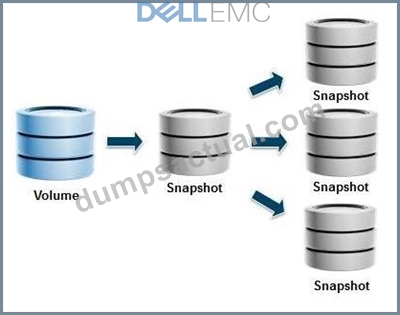
Refer to the Exhibit.
An XtremlO administrator is asked to provide a copy of a 25 TiB database to a group of users. Each user needs to have their own copy of the database in order to perform a variety of manipulations on the dat a. This process needs to be repeated every day of the week. The administrator is concerned about the time it will take to make the initial copy of the database and is investigating the use of snapshots of snapshots.
How does each snapshot impact its ancestor?
- A. Each first access to each snapshot will trigger a COFA from its ancestor
- B. Each first write to each snapshot will trigger a COFW from its ancestor
- C. Each snapshot can be considered a unique volume and has no impact
on its ancestor - D. Each first write to a block of the production volume will trigger a COFW to each child snapshot
Answer: C
Explanation:
In the XtremIO environment, snapshots are treated as unique volumes that are independent of their ancestors. When a snapshot is created, it is essentially a point-in-time copy of the data from the source volume. These snapshots operate independently and do not affect the performance or data integrity of the original volume. Any changes made to a snapshot do not impact the ancestor volume, and vice versa. This allows for efficient use of storage resources and enables multiple users to work with their own copies of the database without affecting the original data.
The process of using snapshots of snapshots, also known as cascaded snapshots, is efficient in XtremIO due to the system's unique data reduction and copy data management (CDM) capabilities. Since only changes from the original are stored, it minimizes the additional storage space required for each user's copy of the database. This approach is particularly beneficial when the same process needs to be repeated daily, as it saves time and storage resources1.
NEW QUESTION # 34
Which RESTful API method is used to retrieve an existing XtremIO configuration?
- A. HTTP POST
- B. HTTP RETRIEVE
- C. HTTP GATHER
- D. HTTP GET
Answer: D
Explanation:
The RESTful API method used to retrieve an existing configuration from an XtremIO system is the HTTP GET methD. This is a standard method used in RESTful APIs for retrieving resources. In the context of XtremIO, the GET method would be used to call endpoints that return information about the system's configuration. For example, a GET request to /api/json/v2/types/clusters would retrieve information about the clusters1. The Official Dell XtremIO Deploy Achievement document will contain specific details on the API calls and should be referred to for the most accurate instructions.
NEW QUESTION # 35
A systems administrator has been informed that a new backup policy has been put in place for 500 production volumes on an XtremIO X2-R array. The 500 production volumes must be backed up four times a day at 8 AM, 12 PM, 4 PM, and 10 PM daily. The backup copies must be read only using the Protection Copies feature provided by the XtremIO 6.x code.
How many days of XtremlO Virtual Copy read only volumes can the array store before the original backups are deleted?
- A. 0
- B. 1
- C. 2
- D. 3
Answer: A
Explanation:
* Backup Policy and XtremIO Virtual Copy: The system administrator needs to ensure that the backup policy using XtremIO Virtual Copy (XVC) can store the required read-only copies without exceeding the storage limits.
* Calculating Days of Storage:
* 500 production volumes are backed up 4 times a day.
* Total copies created per day: 500 volumes * 4 backups/day = 2000 copies/day.
* Assuming the array can store a specific number of copies before older ones are deleted, let's determine the duration:
* Duration Calculation:
* If the array can store copies for 5 days, it can handle: 2000 copies/day * 5 days = 10,000 copies.
* Thus, the array can store the backup copies for 5 days before the original backups are deleted to make space for new ones.
References:
* Dell XtremIO 6.x User Guide
* XtremIO Virtual Copy and Protection Copies Features
* Dell XtremIO Deployment Services
NEW QUESTION # 36
Refer to the exhibit.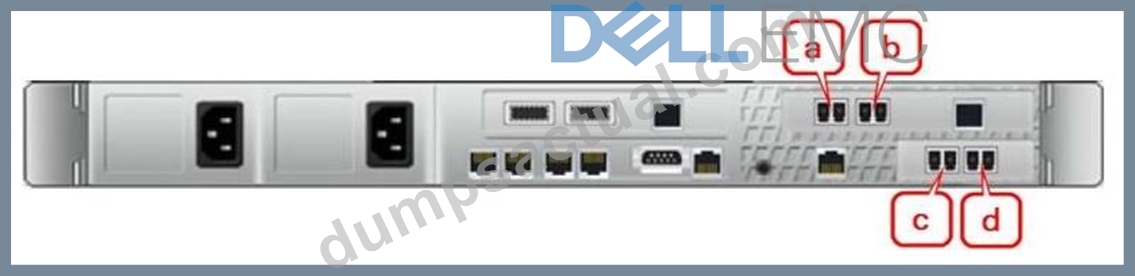
Based on the exhibit, which ports are used for FC2 and iSCSI 1 connections?
- A. a and c
- B. b and c
- C. b and d
- D. a and d
Answer: C
Explanation:
The image provided shows the back panel of a network device, with ports labeled 'a', 'b', 'c', and 'd'. The ports 'b' and 'd' are indicated to be used for FC2 (Fibre Channel 2) and iSCSI 1 connections, respectively. This is inferred from the color coding and labeling typical in network hardware, which helps distinguish between different types of connections. While the Official Dell XtremIO Deploy Achievement documents would provide definitive information, standard network design practices suggest that the correct answer is D. b and d, for FC2 and iSCSI 1 connections respectively.
NEW QUESTION # 37
During the installation of an XtremlO cluster, you configure the ESRS server using a FQDN for Connect Home. During the test, you discover that the XtremlO cluster fails to connect home. What is a possible cause for this issue?
- A. DNS needs to be configured on the ESRS Gateway
- B. Port 25 is blocked on the firewall
- C. DNS needs to be configured on the XMS
- D. ESRS IP for an ESRS configuration can only be used
Answer: C
Explanation:
The XtremIO Management Server (XMS) requires DNS configuration to resolve Fully Qualified Domain Names (FQDN) used in ESRS (Electronic Support Services) configurations. If the DNS is not configured on the XMS, it will not be able to resolve the ESRS FQDN, leading to a failure in connecting home. Configuring DNS on the XMS ensures that all network addresses, including the ESRS server, can be resolved correctly.
References:
* Dell XtremIO Deployment and Learning Course Materials
* XtremIO X2 Configuration Guide
NEW QUESTION # 38
When should the XtremIO X1 DAE power cables of X-Brick 1 be removed?
- A. Shutdown after the initial installation
- B. Shutdown due to power loss
- C. During an emergency shutdown procedure
- D. During a normal shutdown procedure
Answer: C
Explanation:
The power cables of the XtremIO X1 DAE (Disk Array Enclosure) for X-Brick 1 should be removed during an emergency shutdown procedure. This is a critical step to ensure the safety of the hardware and data integrity in the event of an emergency that requires immediate power down of the system.
The process typically involves:
Identifying the Emergency: Recognize the situation that necessitates an emergency shutdown, such as power surges, environmental hazards, or other immediate risks.
Initiating Emergency Shutdown: Engage the emergency shutdown procedure as outlined in the XtremIO documentation. This may involve using emergency power-off (EPO) switches or other mechanisms designed for rapid shutdown.
Disconnecting Power Cables: Once the system is safely powered down, disconnect the DAE power cables from X-Brick 1. This step helps prevent any electrical damage or data corruption that could occur if power is unexpectedly restored during the emergency.
Ensuring Safety: Verify that all power sources are disconnected and that it is safe to handle the cables and hardware.
Documenting the Procedure: Record the steps taken during the emergency shutdown, including the removal of power cables, to assist in any subsequent investigation or system recovery efforts.
NEW QUESTION # 39
When will an administrator receive an alert when "Small IO Alerts" are set to "enabled"?
- A. I/Os <4 KB are detected
- B. I/Os <1 KB are detected
- C. I/Os <8 KB are detected
- D. I/Os <2 KB are detected
Answer: A
Explanation:
The "Small IO Alerts" feature in XtremIO is designed to notify administrators when a significant number of small I/O operations are detected, which could potentially impact the performance of the storage array. The threshold for these alerts is typically set to a default value that considers the architecture and performance characteristics of the system. In the case of XtremIO, the alert is triggered when I/O operations are smaller than 4 KB1. This threshold is set based on the understanding that smaller I/O sizes can lead to inefficient utilization of the storage array's resources and can be an indicator of suboptimal application behavior or configuration.
NEW QUESTION # 40
When creating a volume on an XtremIO X2-S array, which option can be selected?
- A. Cache enabled
- B. Tags
- C. Data block pre-allocation
- D. Thin or thick volumes
Answer: D
Explanation:
When creating a volume on an XtremIO X2-S array, the option that can be selected is related to provisioning the volume as either thin or thick. However, it's important to note that in the context of XtremIO arrays, volumes are always thin-provisioned1. Thin provisioning is a method of optimizing the efficiency of available space, where physical storage is allocated on demand in granular data blocks, rather than pre-allocating a fixed amount of storage to a volume (thick provisioning). This approach allows for more flexible and efficient use of storage resources.
NEW QUESTION # 41
What are the documented sequence of steps to deploy an XMS OVF template?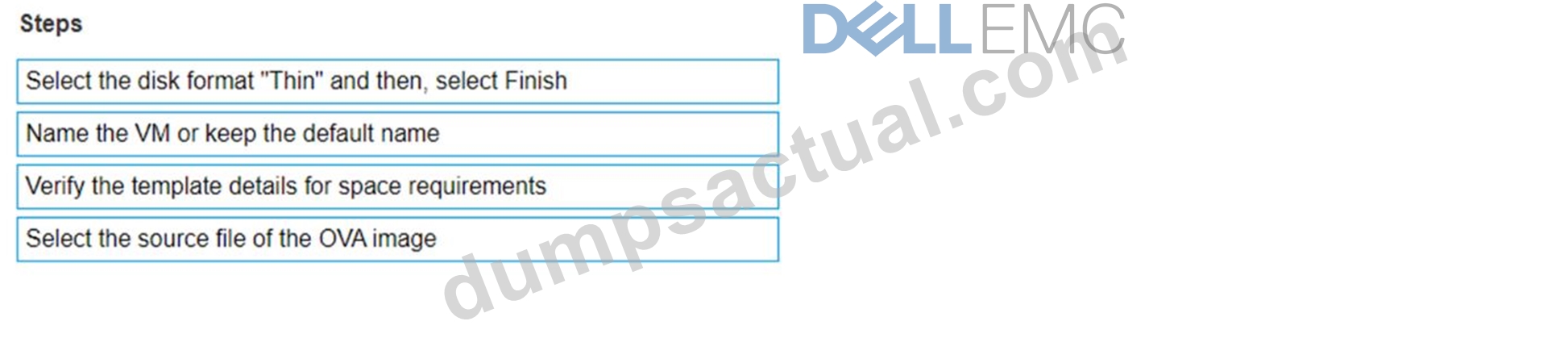
Answer:
Explanation: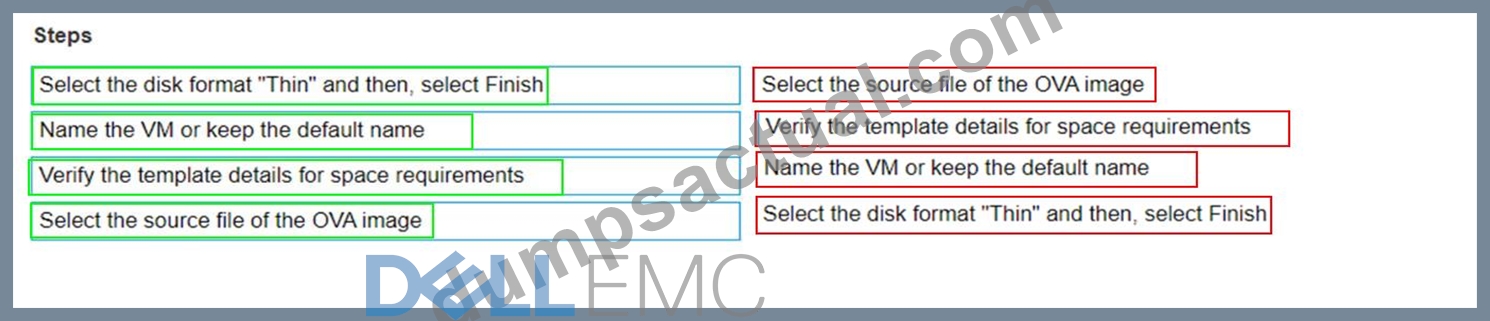
NEW QUESTION # 42
......
EMC D-XTR-DY-A-24 Exam Syllabus Topics:
| Topic | Details |
|---|---|
| Topic 1 |
|
| Topic 2 |
|
| Topic 3 |
|
Updated Exam D-XTR-DY-A-24 Dumps with New Questions: https://exampdf.dumpsactual.com/D-XTR-DY-A-24-actualtests-dumps.html
